(The Finacial Express, Dhaka, 29 November 2014) Nearly 40 per cent of the Tk 25.19 billion (US$323.4 M) sought for a proposed power sector project are set to be spent for less-important matters, including purchase of vehicles and foreign training, officials said Wednesday. Such huge spending of the project money on ancillary things has given rise to questions about proper cost estimation and economic viability of the project, they said… Power Division officials said the PDB signed deal with Swiss company Alstom and Chinese company CMC on January 12 this year for the re-powering of the Ghorashal 3rd power unit… The PDB has also selected the Swiss Export Credit Agency (SERV) and the China Export and Credit Insurance Corporation (SINOSURE) for borrowing Tk 20.19 billion ($259.75 million) buyer’s credits.
ECAWatch Newsletter
ECA Watch releases report ‘ECAs and Human Rights: Failure to Protect’
GENEVA – December 3, 2014.
International civil society network ECA Watch released a new report today titled Export Credit and Human Rights: Failure to Protect at the UN Forum on Business and Human Rights. The report calls on states to fulfill their duty to protect human rights through the operations of their export credit agencies.
ECA Watch and Brazilian network Justiça nos Trilhos shared analysis regarding export credit agencies (ECAs) – public entities that provide multinational companies with financing, insurance and guarantees – on a panel today at the annual UN event.
Failure to Protectuses several case studies to illustrate that ECA-supported investments are often associated with human rights abuse, despite the OECD Recommendation known as the Common Approaches, which provides guidance to ECAs and includes a reference to human rights.
“The massive Carajás iron project in the Brazilian Amazon has harmed local indigenous and Afro-descendant populations, in contravention of local laws,” said Danilo Chammas of Justiça nos Trilhos. “Yet the company that operates the project, Brazilian mining giant Vale S.A., received financing from Export Development Canada, the Canadian export credit agency.”
“The German government provided a guarantee for the Hidrosogamoso dam, which is under construction in Colombia, through its export credit agency, Euler Hermes. The project has devastated the local economy. Since 2009, six community leaders who oppose the project have been killed or disappeared,” said Heike Drillisch from CounterCurrent.
The ECA Watch publication also includes case studies on the Sasan power project in India, which received financing from the US Export-Import Bank; the Suape seaport in Brazil, which was insured by the Dutch ECA, Atradius; and ECA support for investments in Belarus.
“Failure to Protect shows that states must do more to prevent complicity in human rights abuse,” said Karyn Keenan from the Halifax Initiative. “ECAs must be required to undertake effective and transparent human rights due diligence.”
Export Credit and Human Rights: Failure to Protect
http://www.eca-watch.org/publications/ecas-and-human-rights-failure-protect
Activists demand end of massive OECD support for fossil fuels
Press release
Activists demand end of massive OECD support for fossil fuels
This week in Paris, a secretive body within the OECD will discuss the potential revision of the “gentlemen’s agreement” (1) under which they provide billions of dollars of public financing into the fossil fuel sector through their member export credit agencies.
This morning, prior to a meeting with the OECD Export Credit Group, activists from the Export Credit Agency Watch network (ECA-Watch), including Les Amis de la Terre-FoE France, will protest outside the OECD, calling this public institution to enter the 21st century and end its support for fossil fuels.
“We all know that fossil fuels cause all kinds of mayhem, including damage to environment and to human health, violation of human rights and harm to the global climate.And yet rich countries’governments play a crucial role in supporting fossil fuel projects through their Export Credit Agencies,. With the international climate summit in Paris in 2015, the OECD’s moral duty to stop worsening the world’s fossil fuel addiction is even higher: it has to end fossil fuel support if it want to bring something to the fight against climate change””, explains Doug Norlen, Friends of the Earth US, member of the ECA–Watch network (2).
Export Credit Agencies (ECAs) provide governmental-backed guarantees, insurance and loans to private corporations from their home country in order to promote exports and projects abroad. ECA support just for coal, the worst climate killer of the fossil fuels, has been enormous: the OECD ECAs have provided at least 32 billion US$ between 2007 and 2013 for coal plants and mines according to data compiled by the Natural Resources Defense Council (NRDC). (The French government alone, who will host the COP next year, put in 1,2 billion euros to support Alstom exports for just two power stations in South Africa during that time).
“This subsidy stands in stark contradiction to the findings of leading climate scientists. The United Nation’s Intergovernmental Panel on Climate Change made clear that if global warming is to be kept under dangerous levels, the majority of proven fossil fuel reserves will have to be left in the ground” says Lucie Pinson from Friends of the Earth France, as well an ECA-Watch member. The activists want to take OECD’s Secretary General Angel Gurría at his word, who called for every government to consider curbing domestic and overseas support for coal plants.
Today’s reason for the protest is a consultation in the Export Credit Group of the OECD. In this body discussions to consider restrictions on ECA support for coal plants commenced earlier this year with the US, UK and Netherlands proposing to implement an emissions performance standard ruling out future support for coal plants. “However, even this modest move, which focuses only on coal power plants and omits coal mining and infrastructure, is opposed by some retrograde OECD members”, complains Linde Zuidema, ECA-Watch coordinator. “Some OECD governments even dare to propose extended terms (e.g., longer repayment terms) for some kinds of coal plants, which would expand coal use even further. Their domestic coal industry, Alstom, Siemens, or Hitachi, pressures them to put corporate profits above climate, environment and human rights, which is outrageous”, says Zuidema.
Notes:
(1) The Arrangement is a “Gentlemen’s Agreement” amongst its Participants who represent most OECD Member Governments. The Arrangement sets forth the most generous export credit terms and conditions that may be supported by its Participants.
ECA Watch launches Map on popular alternatives
Brussels, 29 October 2014
Global NGO network launches a Map that shows popular alternative proposals for infrastructure to encourage public finance institutions to invest in better projects ECA Watch, a network of non-governmental organizations campaigning for reform of public finance institutions (e.g. Export Credit Agencies) and better implementation of social, environmental and human rights standards launched today a “Map on popular alternative proposals of envisioning infrastructure”.
Linde Zuidema, coordinator of ECA Watch at NGO FERN, says: “The Map can serve as a mean to inform people and support networks on sustainable infrastructure”. The map initially shows cases in Africa, Latin America and Europe. In the future the map will be complemented with more cases throughout the globe.
According to Mónica Vargas, one of the initiators of the project at the Observatory on Debt in Globalisation (ODG), member of ECA Watch: “Infrastructures should be planned paying attention to issues such as: Who decides? Who benefits? The cases selected for the Map show that there are alternative proposals, exemplary because of their ability to respect the needs of all stakeholders instead of just fulfilling capital interests in the North and the South. The main objective of the map is to spread information, proposals and contribute to linking people and groups with each other, in order to enrich the narrative on alternative infrastructure”.
ECA Watch developed the map initially to show cases in the energy, water and transport sector. An example in the energy sector is the National Energy Proposal of the Movimento dos Atingidos por Barragens (Movement of People affected by Dams in Brazil), which includes a Platform that responds to the impacts of large hydroelectric dams in Brazil, integrating people affected by dams (farmers, fishers, indigenous peoples) as well as workers in the energy sector. Its aim is to build another energy model, that plans and organises popular control over the production and distribution of energy, as well as over the wealth it generates. The idea is also to allocate resources and energy generation to people’s real needs, as well as to ensure the protection of the environment.
Another example, in the water sector is the Italian Water Referendum of 2011 and its results: the intention to prevent water privatization and to consider water as a common good. The initiative proposes management of water systems at the municipal level and avoid any interference by free market principles.
You can enter the map here
Contacts for press:
Mónica Vargas , Observatory on Debt in Globalisation (ODG), monica.vargas@odg.cat, +34 66 202 64 97
Linde Zuidema, Eca Watch Coordinator, linde@fern.org, +32 2 894 4694
Sinosure business up by 19.2%
(ECNS.CN, Beijing, 24 July 2014) China Export and Credit Insurance Corp (Sinosure) insured $229.12 billion in the first half of 2014, a year-on-year increase of 19.2 percent, the China Securities Journal reported on Tuesday. Short-term export credit insurance accounted for $181.38 billion; $7.62 billion was in mid to long-term export credit insurance and $18.88 billion was in overseas investment insurance.
British taxpayers underwrote ECA deals worth £140m by Cayman Islands firm
(The Independent, London, 6 July 2014) The Government is using taxpayers’ money to underwrite £140m-worth of deals for a company whose ultimate ownership is based in a notorious tax haven. UK Export Finance, a branch of the Department for Business, is risking public funds to provide insurance cover for deals involving the aircraft leasing firm AWAS Aviation Capital Ltd., controlled by a friend of Foreign Secretary William Hague.
Officials at Ex-Im Bank Face Investigations
(Wall Street Journal, Washington, 23 June 2014) The U.S. Export-Import Bank has suspended or removed four officials in recent months amid investigations into allegations of gifts and kickbacks, as well as attempts to steer federal contracts to favored companies.
End Coal Financing
Starting Monday, June 16, governments in the Organization for Economic Cooperation and Development (OECD) will meet to discuss financing through their Export Credit Agencies – public agencies that fund or guarantee private corporations from their home country to invest or export overseas.
These governments have the opportunity to end Export Credit Agency financing for coal – a key part of the larger effort to end public financing for fossil fuels and high carbon projects. Between 2007 and 2013 national Export Credit Agencies from OECD countries provided at least $32 billion for coal projects abroad – over 60 percent of total public support for coal over this period!
Civil society organizations around the world are coming together on Wednesday, June 11 to tell governments to #EndCoalFinance. Here’s what you can do to help:
- Join the twitterstorm and tell OECD governments to support a ban on coal financing! Sample tweets are here.
- Read the joint NGO statement by 51 groups in 17 countries to end support for fossil fuels here.
- Check out World Wildlife Fund’s infographic below or download it as a PDF.

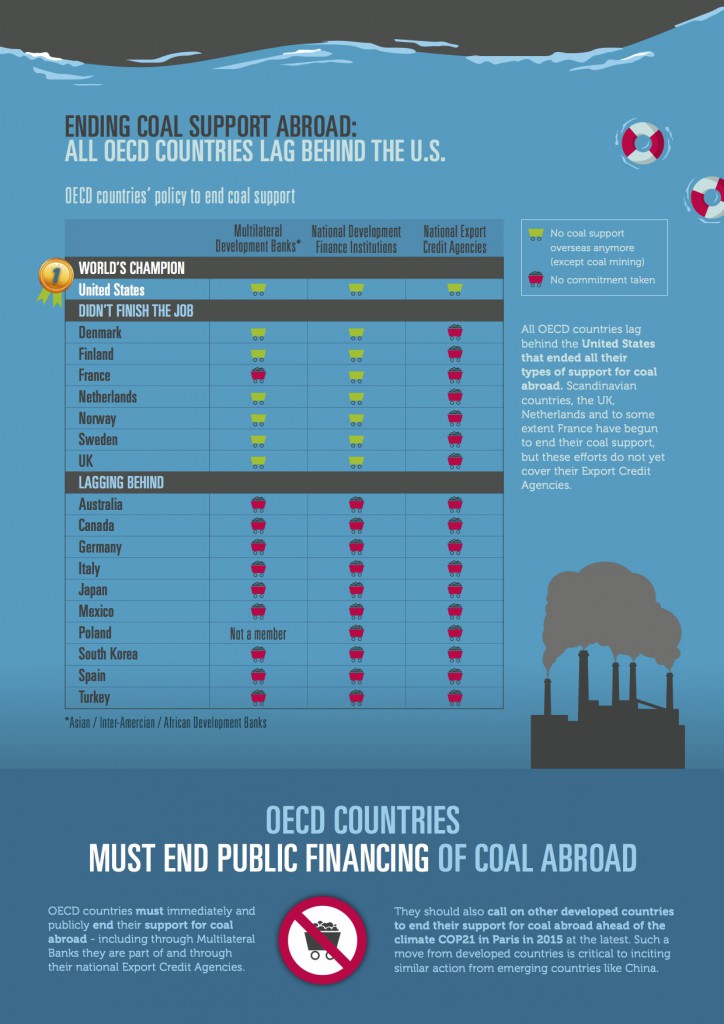
General tweets:
- Time for @OECD to stop exporting #climate chaos. Say no to export credits and guarantees for #coal! #endcoalfinance bit.ly/1hJSyFs
- #Coal is not clean. @OECD @EU_Commission say no to export credits and guarantees for coal. #endcoalfinance bit.ly/1hJSyFs
- Coal won’t solve the poor’s energy access needs. Time to put a ban on export credits and guarantees for #coal in @OECD! #endcoalfinance
- Renewables are 15 times cleaner than the “cleanest” coal. Time to put an end to export credits and guarantees for #coal! #endcoalfinance
Country-specific tweets for France, Germany, Finland, Japan, and Korea:
France:
- Time to stand up, @fhollande. Say no #coal finance & guarantees through export credit agencies @OECD! #endcoalfinance bit.ly/1hJSyFs
- .@montebourg: Lead @OECD on #climate. Ban export credit agency financing & guaranteeing for #coal! #endcoalfinance bit.ly/1hJSyFs
- .@LaurentFabius: Lead @OECD on #climate. Ban export credit agency financing and guaranteeing for #coal! #endcoalfinance
- Coal is NOT sustainable. @RoyalSegolene: end export credit agency finance & guarantees for #coal! #endcoalfinance bit.ly/1hJSyFs
- .@montebourg soyez leader à l’ @OECD sur le #climat. Stoppez les soutiens à l‘export au #charbon! #endcoalfinance http://ow.ly/xP59w
- Il est temps d’agir, @fhollande. Dites-non aux soutiens à l’export #charbon à l’@OECD! #endcoalfinance http://ow.ly/xP59w
- Soyez leader à l’@OCDE_francais – @coface, dites non aux soutiens à l’export du #charbon !
http://ow.ly/xP59w #endcoalfinance - .@LaurentFabius soyez leader @OECD sur le #climat. Stoppez les soutiens à l‘export au #charbon! #endcoalfinance http://ow.ly/xP59w
- Le charbon n’est PAS durable.@RoyalSegolene: stoppez les soutiens à l‘export au #charbon! #endcoalfinance http://ow.ly/xP59w
Germany:
- Stand up, @Angela_Merkel! Say no #coal finance & guarantees through export credit agencies @OECD! #endcoalfinance bit.ly/1hJSyFs
- Germany and @Angela_Merkel: don’t export #climate change. Put a ban on export credits for #coal! #endcoalfinance bit.ly/1hJSyFs
- Aktiv werden, @Angela_Merkel! Sagen Sie Nein zu #Kohlefinanzierung und –verbürgung durch @OECD-Exportkreditagenturen! bit.ly/1l2rqRo
- Deutschland und @Angela_Merkel: nicht länger #Klimawandel exportieren. Stoppen Sie Exportkredite und –bürgschaften für #Kohle! bit.ly/1l2rqRo
Finland:
- .@Vapaavuori: stand up for a full ban on #coal export credits. Coal is never clean! #endcoalfinance bit.ly/1hJSyFs
- .@VilleNiinisto: Help lead @OECD away from exporting #climate chaos. Ban export credits for #coal! #endcoalfinance bit.ly/1hJSyFs
- Finland and @Vapaavuori: don’t export #climate change. Put a ban on export credits for #coal! #endcoalfinance bit.ly/1hJSyFs
Japan:
- It’s time for PM @AbeShinzo to put an end export credits for #coal. Coal is never clean. #endcoalfinance bit.ly/1hJSyFs
- .@AbeShinzo, say no to dirty coal at home and abroad! Support a ban on #coal export credits. #endcoalfinance bit.ly/1hJSyFs
- The whole world’s watching. Will @AbeShinzo support a ban on export credits for dirty #coal? #endcoalfinance bit.ly/1hJSyFs
Korea:
- It’s time for @mosfkorea to put an end export credits for #coal. Coal is never clean. #endcoalfinance bit.ly/1hJSyFs
- .@mosfkorea, say no to dirty coal at home and abroad! Support a ban on #coal export credits. #endcoalfinance bit.ly/1hJSyFs
This is a test, it’s got some non-alphanumeric characters & the like
If this was a real item, there would be something to put here…
France Must End Public Financing of Coal
(Friends of the Earth France, Paris 10 February 2014) Tomorrow French President Francois Hollande will meet US President Barack Obama. Last year, Mr Obama announced the end of US public financing for new coal-fired power plants overseas, he now wants other developed countries to follow suit. In September 2013, the leaders of Denmark, Finland, Iceland, Norway and Sweden signed an agreement with the US accepting this challenge. Environmentalists want Mr Hollande to use his US visit to show that France is ready to be part of this group and commit to end all French public support to coal. France has already pledged to stop coal financing through its development agency. Now Friends of the Earth is urging President Hollande and his government to finish the job and end support for coal-fired power plants via its export credit agency and the various multilateral development banks in which it plays a significant role. This decision is vital if France is to retain its credibility as a true leader on climate change and host of the international climate negotiations, which will take place in Paris in 2015. Indeed, Mr Hollande and Mr Obama have issued a call for other nations to join them in seeking an “ambitious” agreement to tackle climate change in a joint article published in Le Monde and the Washington Post this morning. Both must now back up their words with stronger and faster actions to cut emissions, and President Hollande can make an important step by phasing out public finance for new coal.
