
Both ENDS
Campaigners say EU due diligence laws should apply to ECAs
(Global Trade Review, London 19 January 2022) A planned European Union law requiring large and businesses and financial institutions to conduct human rights and environmental due diligence should also apply to export credit agencies (ECAs), activists say. The initiative has strong support from the European Parliament but the Commission’s draft text has been held up twice by a regulatory oversight board that scrutinises proposed laws, according to MEPs. In December last year, four MEPs blamed the delays on lobbying by business groups in France and Denmark, and requested access to the board’s opinions on the draft proposals, which are not usually published until proposals are formally adopted. ECA Watch, a network of global non-government organisations who argue for ECA reform and transparency, sent a letter to the Commission in November urging ECAs to be in scope of the proposed law, noting” “Active obligations from ECAs [under the law] will effectively encourage a significant number of companies to fulfil their due diligence obligations and ensure that also ECAs themselves effectively comply with the human rights and environmental obligations of the member states on whose behalf they operate… Past experience shows that export credit guarantees are repeatedly granted for projects with serious adverse human rights and environmental consequences.” One of the letter’s authors, Heike Drillisch from German human rights and environment initiative CounterCurrent, says that while ECAs judge projects against standards such as the UN Guiding Principles on Business and Human Rights, they may not take an interest in the companies involved and whether they are respecting human rights. “We say that as state money is involved in export credit schemes, there should really be a heightened due diligence process in place and ECAs should be aware of not becoming complicit in human rights violations which occur in the project,” Drillisch tells GTR. Lawmakers want to capture non-EU firms too. A non-binding European Parliament resolution on the proposed law, adopted by 504 votes to 79, called on EU governments not to allow access to ECA support for companies that do not comply with the “objective” of the law. Asked how likely it is that public finance and insurance bodies such as ECAs will be in scope of the legislation, Linklaters associate James Marlow says to the extent that such organisations “are public bodies and extensions of member state governments, it is less likely that they will be directly captured by any regime… on mandatory due diligence”. However, Marlow tells GTR, to avoid reputational damage “it is possible that such bodies would be impacted indirectly as they or their government may look to align their policies and processes with stakeholder expectations and obligations” that apply to their counterparts in the private sector.
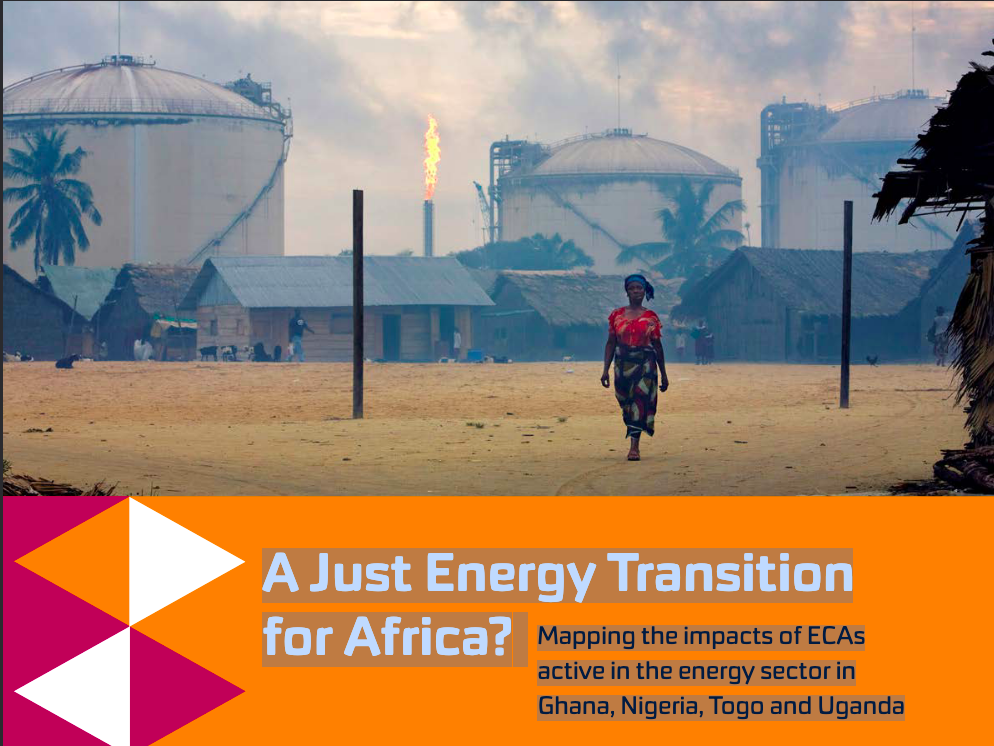
Report: A Just Energy Transition for Africa? Mapping the impacts of ECAs active in the energy sector in Ghana, Nigeria, Togo and Uganda
Report: A Just Energy Transition for Africa? Mapping the impacts of ECAs active in the energy sector in Ghana, Nigeria, Togo and Uganda
Atradius DSB launches ‘Green Label’ to promote greater environmentally responsible export transactions
(Both ENDS, Amsterdam, 29 January 2021). Atradius Dutch State Business (ADSB) recently launched the so-called “Green Label”. This is a methodology to determine whether a transaction can be qualified as a green transaction. Such green transactions are eligible for export credit insurance with specific, more attractive terms and conditions:
- Cover for up to 95% – in stead of the usual 70-90% – of the total value of project finance transactions;
- Flexible acceptance criteria for small green transactions up to €5 million;
- Flexible definition of export, allowing cover for domestic transactions that have export potential in the long run.
The green label is also meant to be a tool to determine the share of green transactions in ADSB’s overall portfolio. Starting from 2019, ADSB annually reports on this.
Aligning itself with the International Finance Corporation (IFC) and the Netherlands Finance Corporation for Developing Countries (FMO), ADSB reviews whether transactions contribute to:
a) reduction of climate change (mitigation); or
b) adaptation to the impacts of climate change; or
c) reduction of ecological footprint beyond local legal requirements.
The Green Label distinguishes 11 categories of ‘green’ business, which in their turn have a total of 36 sub-categories. In an Annex to the document an overview – Green List – is provided of various types of business within each of these categories.
Depending on the intensity of the contributions of transactions to the environment or climate, they are identified as dark green, middle green or light green, but that does not affect their eligibility for the specific favourable terms and conditions for green transactions. The current Green Label will be valid for one year (to December 2021) and evaluated thereafter to ensure it incorporates further insights and developments.
It is observed that the Green Label aligns well with the EU taxonomy. However it is also noted that there can be differences between the two since the EU taxonomy is valid only for transactions within the EU, while ECA backed transactions are usually located outside the EU.
Both ENDS notes that this distinction between standards within the EU being different from the standards that ECAs may observe abroad is problematic, particularly where it relates to values and concerns that are universal. This is clearly the case where we need to address issues such as climate change, environmental standards or human rights.
Overall Both ENDS welcomes the Green Label as an effort to open up for further dialogue on the green qualifications of specific transactions. Many CSOs might question – for example – whether hydro dams for electricity, biomass, refurbishing thermal power plants or industrial farming should qualify for the label green, or instead a brown label.
Equally, we hope ADSB and other ECAs will prioritize effective instruments to put an end to support for transactions with obvious negative environmental and climate impacts, such as transactions supporting the exploration and production chains of all fossil fuels. Following recent announcements by the UK government and the new Biden administration in the USA to phase out public support for fossil fuels, it becomes high time for all ECAs to follow suit.
Mapping the impacts of ECAs active in Africa
(Both Ends, Amsterdam, 11 November 2020) Many industrialised nations are switching to renewable energy at home. But while they commit to phasing out fossil fuel energy domestically, these commitments are abandoned outside their borders, where they continue to push dirty energy, thus contributing to climate change, human rights abuses and environmental destruction. This is happening in African countries, while they are already being hit particularly hard by the impacts of climate change. By supporting fossil fuel as well as large hydro dam-related energy projects in Africa, export credit agencies (ECAs) add to the many risks and threats. In addition, the ECA-supported investments in fossil fuels makes these countries economically dependent on energy sources that many countries in the world are committed to phase out, which poses serious economic debt risks, undermining their long-term resilience. Coming from a perspective of communities affected by ECA-supported energy projects, this report analyses the question what the best solution is for limiting global warming to 1.5C on the one hand, and facilitating universal energy access on the other hand. Furthermore, it analyses the question what the role of public financial institutions like ECAs could be in terms of promoting a green energy future in Africa.
ECAs, COVID-19 and Climate: Recommendations to Ensure that Economic Support Protects People and the Planet
(ECA Watch members, 10 August 2020) This 9 page report finds that while ECA responses to COVID-19 are still quickly evolving, it’s now clear that these institutions are:
- Providing more favorable financing terms;
- Expanding the geographic scope of the projects and companies they are supporting, including new domestic coverage that was very rare for ECAs prior to COVID-19;
- Failing to ensure proper transparency and oversight of who is getting this support and how it is being used;
- Increasing risks of corruption, human rights abuses, and environmental destruction;
- Potentially increasing support for megaprojects like Mozambique LNG that has already received billions from ECAs; and
- Potentially supporting many oil and gas companies that were already financially unviable even before the COVID-19 crisis.
The report’s recommendations include that ECAs must:
- Ensure that their COVID-19 responses are in line with the Paris Agreement’s 1.5 degree Celsius target and the Sustainable Development Goals;
- Continue progress on climate policies and protections, including explicitly excluding support for fossil fuel related projects;
- Promote transparency by providing detailed, public information on all support provided at the time the support is provided; and
- Uphold all standards on social and environmental due diligence
ECAs play lip service to coal withdrawal but ignore oil & gas
(CIS University of Zurich, 2 April 2020) ECAs are a hitherto under-researched contributor to lock-in of fossil fuel infrastructure. This study reviews external policies and standards as well as internal policies and commitments that may affect ECAs’ portfolios – specifically their support to fossil fuel and low-carbon technology projects. Most international standards are applied on a purely voluntary basis. Moreover, they are mainly focused on increasing transparency and promoting social and environmental safeguards while not directly affecting the ECAs’ portfolios. Most importantly, none of them has explicit requirements to phase out support to fossil fuels and align operations with the Paris Agreement. The standards thus do not support fossil fuel project support phaseout.
Both ENDS: Export credit insurer Atradius played a crucial role in Angola
Translation of the original piece in Dutch found at the above link.
Opinion | Daniëlle Hirsch is director of Both ENDS
This week it came to light in the Dutch newspapers FD and Trouw that the Dutch offshore company Van Oord, ING and the Dutch export credit insurer Atradius Dutch State Business (ADSB) are involved in human rights violations and large-scale corruption in Angola. A crucial role is reserved for ADSB, which, on behalf of the Dutch state, insured the activities of Van Oord in Angola against financial risks.
Purely because ADSB covers the risks of projects such as in Luanda, banks such as ING are stepping into these types of risky companies: Without the services of ADSB they will not come about. Minister of Finance Wopke Hoekstra and Minister of Foreign Trade Sigrid Kaag must highlight the dubious role of ADSB in Dutch trade policy and call the company to account.
ADSB itself must investigate the history and possible impact on people and the environment on site, before insuring high-risk projects. The export credit insurer does too little to prevent Dutch companies from becoming involved in corruption and human rights violations.
We also see this in a project in the Suape port in Brazil, where ADSB provided credit insurance – also to Van Oord. Dredging caused environmental damage and people, just like in Angola, were driven out of their homes.
It appears that ADSB has not had contact with the affected communities in Luanda. In general, the company is happy to leave talking to fishermen, farmers or city dwellers to its client, in this case Van Oord, which only has to prove on paper that it has looked at possible environmental and human rights effects. If afterwards something turns out to be wrong, then all responsibility for this lies with the customer and in the most extreme case the insurance is withdrawn. In this way ADSB remains a driver of foreign deals, but it is never to blame. This does not comply with the OECD Guidelines for Multinational Enterprises, which it expects its customers to comply with.
The crucial role of ADSB in export policy and the responsibility that the Dutch state has in this regard receive no attention from the press, the public and the House of Representatives, while this is necessary.
Daniëlle Hirsch is director at the environmental and human rights organization Both ENDS
Luanda leaks show Dutch Export credit insurer Atradius involved in serious Angola human rights violations
(Guardian, Luanda, 20 January 2020) Until the summer of 2013, Areia Branca, a fishing village just outside Luanda, the capital of Angola, was home to a thriving fishing community of 3,000 families. Now there is no trace of their houses, only sand, a pile of gravel, egrets, a bulldozer and a police post, bulldozed to make way for the Marginal da Corimba project, a multibillion-dollar real estate and highway development along Luanda’s coastline led by Isabel dos Santos, the daughter of Angola’s former president José Eduardo dos Santos. The Luanda Leaks investigation based on a huge cache of financial records belonging to dos Santos, Africa’s richest woman, suggest her company stood to benefit from redevelopment of the vacated land. Many of Areia Branca’s former residents have moved to the other side of the lagoon, packed on to a tiny patch of land, known as Povoado. Previously a waste dump through which two sewage channels flowed, it has become home to 500 families sharing tiny shacks made of corrugated tin. Children play among piles of rotting rubbish. Infectious diseases – malaria, tuberculosis, meningitis – are rife. Documents released by the International Consortium of Investigative Journalists suggest dos Santos’ Urbinveste received at least $12 million from the Angolan government for work on the project. British architects Broadway Malyan and Dutch dredging company Van Oord claim not to have been aware of the forced evictions on behalf of the dos Santos real estate and construction company Urbinveste. Following revelations in the Dutch business press, a Both ENDS opinion piece in the Dutch business newspaper FD notes that the official export credit insurer Atradius DSB has not complied with OECD Guidelines for Multinational Enterprises. It appears that the Dutch ECA failed to do sufficient due diligence on environmental and human rights impacts and bribery risks before issuing an insurance to facilitate Van Oord and the Dutch ING bank’s involvement in this project.
