(Friends of the Earth Japan, Tokyo, 26 April 2024) From the straits of the Philippines to the coasts of the United States, Japan’s fossil fuel financing is harming the environment, climate, and communities at a time when the world is reeling from the ever-intensifying heat waves, floods, droughts, and typhoons brought by the climate crisis. While the world must phase out fossil fuels, as affirmed by the outcomes of COP28, Japan continues to funnel billions of dollars to liquefied natural gas (LNG) projects through its public institutions like the Japan Bank for International Cooperation (JBIC). In Southeast Asia alone, JBIC provided USD 3.31 billion to LNG projects that harm communities, derailing the region’s just transition to renewable energy. The Natural Resources Defense Council notes that “Japan stands out as one of the world’s top providers of public finance for gas, and the world’s largest provider of international public finance for LNG export capacity, providing $39.7 billion for projects built from 2012 onwards. Just in the two weeks ahead of Kishida’s meeting with Biden, Japan approved over $2.7 billion in financing for new gas projects, such as the controversial gas field in Australia, Block B gas project in Vietnam, the San Luis Potosi and Salamanca gas plants in Mexico, and financing to import LNG.”
Friends of the Earth Japan
Small nuclear reactor, funded by JBIC, is cancelled
(Friends of the Earth Japan, 13 November 2023) NuScale Power, a U.S.-based company, has announced the cancellation of its plan to build a small nuclear reactor in Idaho, U.S. The Japan Bank for International Cooperation (JBIC), had invested in NuScale in April last year, together with JGC Holdings Corp. and IHI Corporation. JBIC’s investment in NuScale was $110 million. At the time of JBIC’s investment, we pointed out that even under their new guise of “small modular reactors,” SMRs are no different from conventional nuclear power plants in that they have problems such as radioactive contamination over their life cycle, nuclear waste, accident risk, and the risk of becoming targets of terrorism and war. We also pointed out that SMRs, which are touted for their economic efficiency, actually increase the cost per unit of electricity generated, and argued that investors should not invest in high-risk SMRs.
Comments to NEXI opposing Cameron LNG

Comments to NEXI opposing Cameron LNG
CSOs demand reduced OECD ECA support for oil and gas
(Price of Oil, Washington, November 2022) This document signed by 54 international civil society organizations outlines how the OECD Arrangement on Officially Supported Export Credits can align with the Paris Agreement warming target of 1.5°C by placing restrictions on export support for oil and gas projects and associated infrastructure. These restrictions build on the existing prohibition on coal-fired power, which came into effect 1 January 2022 and was preceded by the coal-fired power sector understanding (CFSU).
JBIC and Private Banks Must Reconsider Decision to Finance LNG Canada Project
(Friends of the Earth Japan, Tokyo, 29 October 2021) The Japan Bank for International Cooperation (JBIC), a public financial institution fully owned by the Government of Japan, announced in a press release today that it has decided to provide up to US $850 million for the LNG Canada Project. The LNG Canada project plans to liquefy shale gas extracted from Montney, British Columbia and transported through its 670 km Coastal Gaslink pipeline to Kitimat for export to Asian markets.The decision by JBIC ahead of the 26th session of the Conference of the Parties (COP 26) to the United Nations Framework Convention on Climate Change (UNFCCC) starting from the end of this week in Glasgow, England, goes against the call by the UK government to stop public financing for fossil fuels, and shows that Japan’s approach to climate change is still far from that of the rest of the world. It is inevitable that Japan will once again become the target of criticism from the international community. Serious violations of indigenous peoples rights have been pointed out in an associated project of the LNG Canada project. We strongly condemn JBIC’s decision to provide financing, disregarding the impact on climate change and the human rights of Indigenous Peoples, and call on involved operators and financial institutions to immediately withdraw from the project.
NGOs Strongly Oppose JBIC Decision to Support Vietnamiese Coal-fired Power Generation Project
(FOE Japan, Tokyo, 29 January 2021) JBIC, a public financial institution, announced it’s decision on December 28 to provide project financing of up to US $636 million to the Vung Ang 2 coal-fired power generation project in Vietnam. The private-sector financial institutions participating in the cofinancing are believed to include Sumitomo Mitsui Banking Corporation, MUFG Bank, Mizuho Bank and Sumitomo Mitsui Trust Bank. Vung Ang 2 has been criticized internationally, and many problems with the project have been pointed out. The signatory NGOs strongly oppose JBIC’s decision to support the project and its failure to be accountable or address many criticisms, which include the project’s inconsistency with climate change measures and inadequate environmental impact assessments. The project was originally to be sponsored by Hong Kong-based CLP Holdings together with Mitsubishi Corporation, but CLP announced its coal phase-out policy in December 2019 and decided to withdraw from the project. Standard Chartered Bank of the UK, OCBC Bank and DBS Bank of Singapore, all of which had been considering financing, also withdrew from the project. General Electric, which was expected to participate in the project announced on September 21 2020 that it would “exit the new build coal power market”. In addition to JIBC, the Export-Import Bank of Korea (Kexim) and a group of private lenders, will provide nearly US$1.8bn in loans for the project.
ECAs, COVID-19 and Climate: Recommendations to Ensure that Economic Support Protects People and the Planet
(ECA Watch members, 10 August 2020) This 9 page report finds that while ECA responses to COVID-19 are still quickly evolving, it’s now clear that these institutions are:
- Providing more favorable financing terms;
- Expanding the geographic scope of the projects and companies they are supporting, including new domestic coverage that was very rare for ECAs prior to COVID-19;
- Failing to ensure proper transparency and oversight of who is getting this support and how it is being used;
- Increasing risks of corruption, human rights abuses, and environmental destruction;
- Potentially increasing support for megaprojects like Mozambique LNG that has already received billions from ECAs; and
- Potentially supporting many oil and gas companies that were already financially unviable even before the COVID-19 crisis.
The report’s recommendations include that ECAs must:
- Ensure that their COVID-19 responses are in line with the Paris Agreement’s 1.5 degree Celsius target and the Sustainable Development Goals;
- Continue progress on climate policies and protections, including explicitly excluding support for fossil fuel related projects;
- Promote transparency by providing detailed, public information on all support provided at the time the support is provided; and
- Uphold all standards on social and environmental due diligence
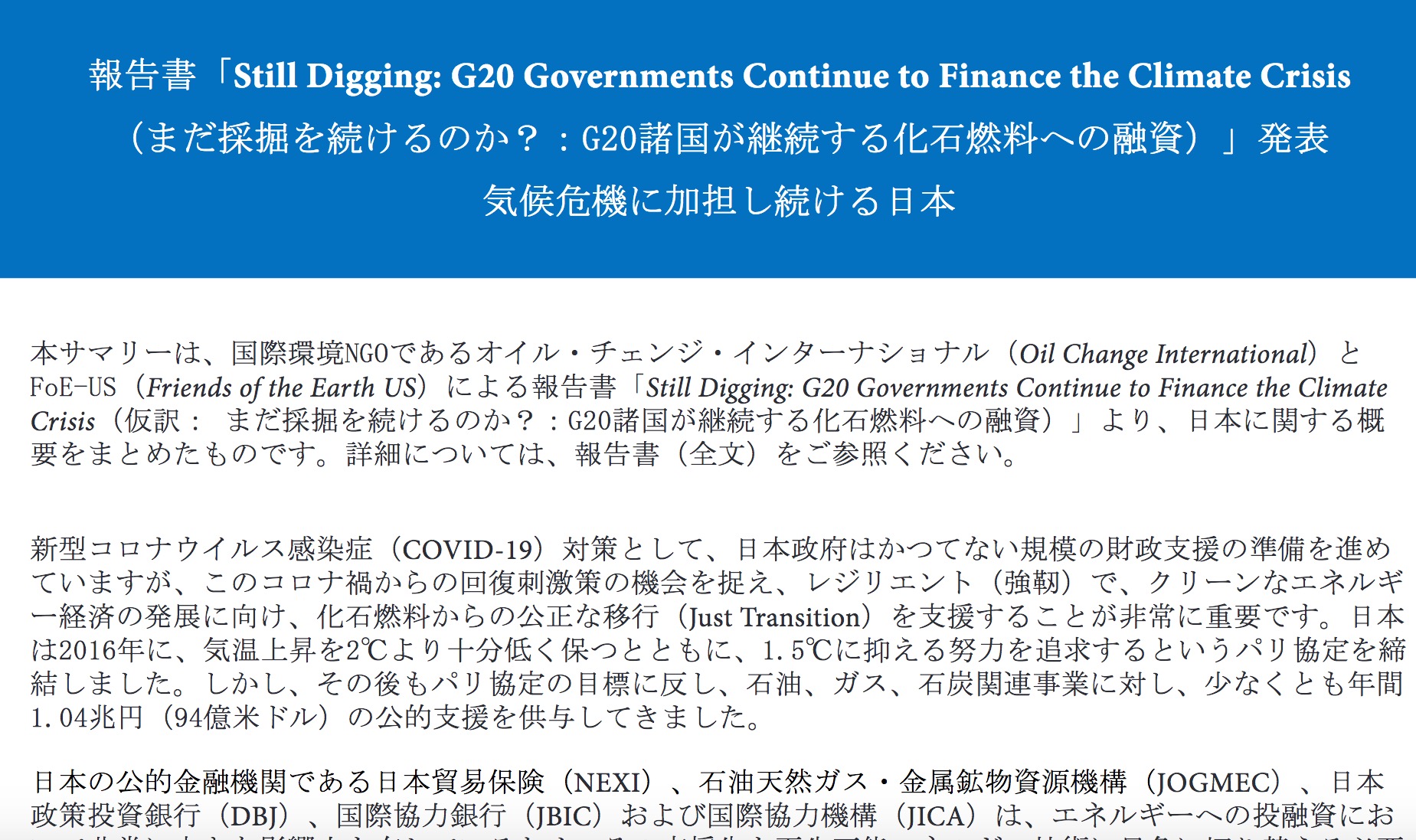
Report (in Japanese): Still digging issue brief
