Jubilee Australia
NGOs submit formal Equator Principles complaint against potential financiers of the Papua LNG project

Export Finance Australia policy would rule out financing to Papua LNG
Export Finance Australia policy would rule out financing to Papua LNG
Australian Government sued for failing to report the climate and biodiversity impacts of subsidising fossil fuel projects
(Jubilee Australia, NSW, 18 July 2023) Jubilee Australia, a human rights and environmental organisation, has filed legal proceedings this morning (18th July) in the Federal Court of Australia against federal government agencies that subsidise new fossil fuel projects but don’t disclose the full environmental impacts of those activities. The claim is against Export Finance Australia (EFA) which is Australia’s export credit agency, and the Northern Australia Infrastructure Facility (NAIF), a $7bn fund for infrastructure in northern Australia. Both provide taxpayer-subsidised finance for risky new fossil fuel and related projects that would otherwise not go ahead. “There are very real fears that without clearer climate commitments, EFA and NAIF could fund infrastructure in Darwin designed to support a massive expansion of fossil gas – such as Middle Arm, or to subsidise some of the world’s largest fossil fuel companies such as TotalEnergies and ExxonMobil’s Papua LNG project in Papua New Guinea, similar to what EFA has previously done,” Luke Fletcher Director of Jubilee Australia said.
CSOs demand reduced OECD ECA support for oil and gas
(Price of Oil, Washington, November 2022) This document signed by 54 international civil society organizations outlines how the OECD Arrangement on Officially Supported Export Credits can align with the Paris Agreement warming target of 1.5°C by placing restrictions on export support for oil and gas projects and associated infrastructure. These restrictions build on the existing prohibition on coal-fired power, which came into effect 1 January 2022 and was preceded by the coal-fired power sector understanding (CFSU).
Korean ECAs sued to stop deep-sea oil pipeline
(BBC, London, 23 March 2022) Tiwi Islands and Larrakia Traditional Owners in Australia’s Northern Territory and youth activists in South Korea have taken the South Korean government to court to stop it from financing Santos and SK E&S’ offshore deep sea Barossa gas project. The legal challenge could prevent the South Korean Government from lending some $AU964 million (US$722m) to the $4.7 billion Barossa gas project via its export credit agencies, the Export-Import Bank of Korea (KEXIM) and the Korea Trade Insurance Corporation (K-SURE), putting the financial viability of the entire project at risk. The Traditional Owners argue they have not been consulted about the project – which threatens their sea country and way of life – and therefore have not been given the opportunity to give their free, prior and informed consent for it to proceed. Plans for the gas project include a 300km-long pipeline to be built through their sea country, an area under their legal jurisdiction. Traditional Owners fear impacts to cultural sites, turtles and other marine life that are central to their culture and the local ecotourism industry. Energy giant Santos is pushing ahead with development for the major new gas field off the coast of Darwin, in what it says is the biggest investment in Australia’s oil and gas industry in almost a decade.
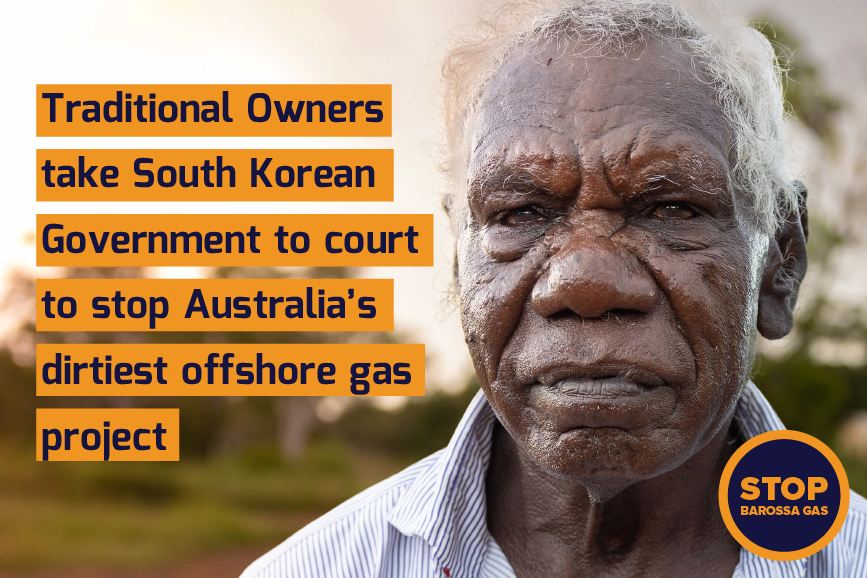
Tiwi, Larrakia Traditional Owners take South Korean government to court to stop offshore gas project
Tiwi, Larrakia Traditional Owners take South Korean government to court to stop offshore gas project
Australian ECA gives 80X more to fossil fuel projects than renewables
(Guardian, Sydney, 6 July 2021) Australia’s export credit agency provided more than $1.5bn in finance to fossil fuel projects between 2009 and 2020, about 80X what it spent on renewables, according to a new report from Jubilee Australia. Over the same 11-year period, covering the hottest years on record globally, it provided $20m in support to renewables projects. Luke Fletcher, executive director of Jubilee Australia, argues that EFA’s support for fossil fuel projects “bucks the international trend”, risks investing in doomed projects and curtails opportunities for the country’s energy sector to modernise. Export Finance Australia has also been criticized for taking on a role as a Development Finance Institution (DFI), adding equity stakes in risky overseas infrastructure to its export insurance and lending powers in order to to compete with Chinese, Japanese and Korean ECAs. For some, this sort of reform blurs the distinction between the government and the private sector, and at worst is a form of corporate welfare, blurring the line between helping developing countries vs Australian business. Australia is the world’s largest exporter of coal and gas, yet producers in those sectors are finding it increasingly difficult to source financing from commercial lenders.
